There is a tendency when talking about AI projects to start with the technology. What model are we using? Is it an agent? What can it automate? How sophisticated is it?
A small project we've recently been working on with Go Dharmic reminded me that sometimes the more interesting place to start is much simpler: where is someone's time going, and could we give some of it back?
Go Dharmic works to encourage selfless service and “compassion in action”, including food distribution through volunteer-led activities around the world. Go Dharmic
For chapters preparing fresh food, however, the activity starts well before anybody serves a meal.
A lot happens before the cooking starts
Imagine you're preparing a meal for a large community feeding. You might already have a recipe, but it probably wasn't written for the number of people you're about to serve.
Someone needs to scale it. Ingredients containing meat or other animal products may need replacing. Quantities need calculating, equipment needs checking, cooking needs breaking into stages and volunteers need to know what they're doing and when.
Then there are practical considerations such as packing, storage, allergens and shopping.
This work isn't necessarily difficult, but it takes time. And when the people doing it are volunteers, that's time they could potentially spend elsewhere.
The same issue appeared across Go Dharmic chapters preparing fresh food, so we started looking at whether a GPT could take some of that repetitive planning work away.
From a recipe to a batch-cooking plan
The idea was to make the starting point as natural as possible.
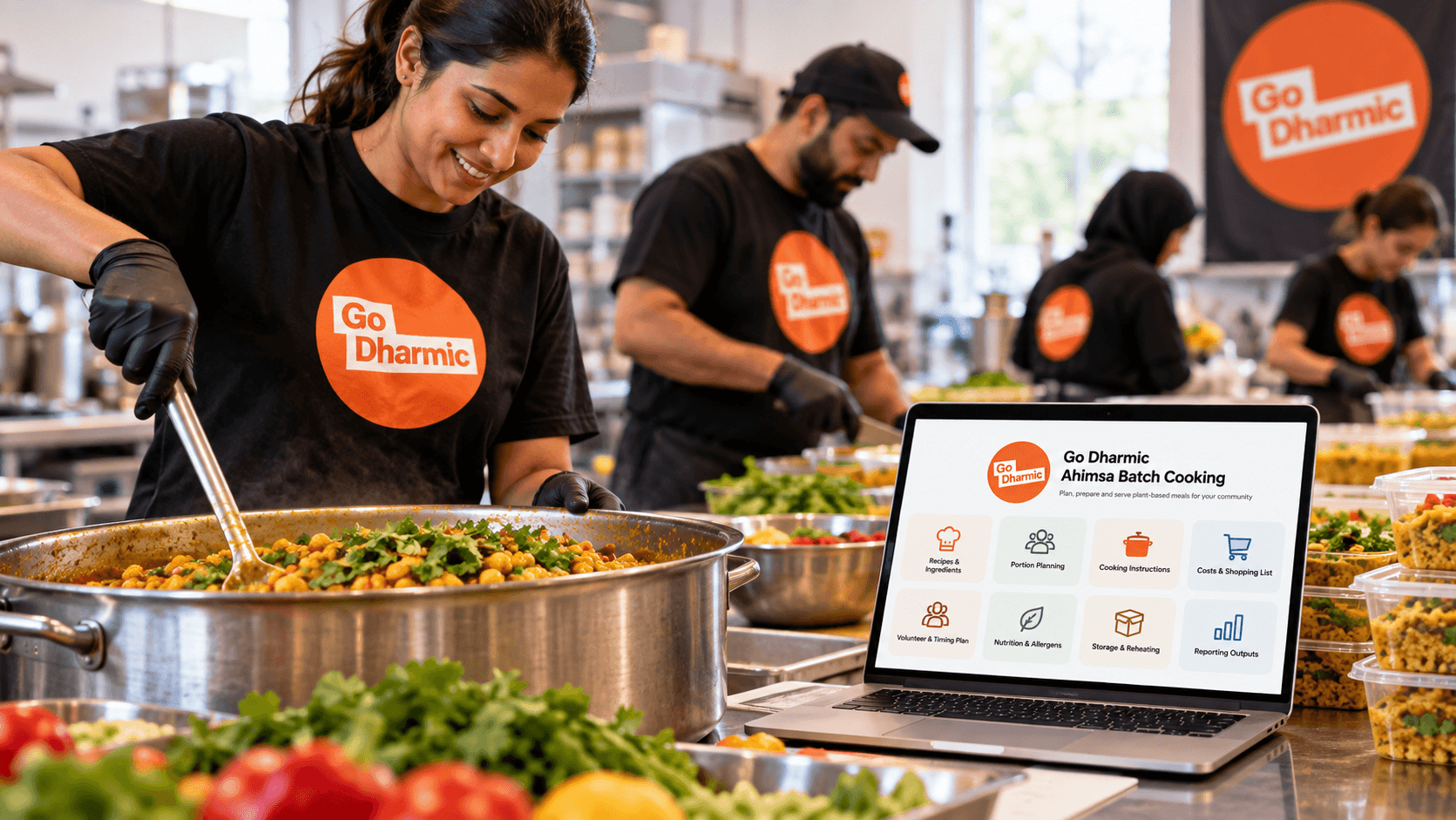
Someone first provides information about their kitchen setup. They can then give the GPT a recipe name, link to an existing recipe or ask it for meal suggestions.
From there, the tool can help create a full batch-cooking plan including the number of servings, ingredient quantities and substitutions, equipment, cooking instructions, packing, timings and volunteer requirements, nutrition information, allergens, storage and reheating guidance, estimated total and per-portion costs, and a shopping list.
After the meal has actually been prepared, the user can also feed practical experience back into the next plan. Perhaps there was too much food. Maybe the quantities were right but the dish needed more flavour. That information can be considered the next time rather than every feeding being treated as if it were the first.
There is still human responsibility here. AI-generated information involving allergens, nutrition, food safety, storage, reheating and costs should be checked rather than treated as guaranteed simply because a system produced it.
The purpose isn't to remove the people who know what they're doing. It's to give them a better starting point.
One process can solve more than one administrative problem
One of the useful things about looking at the whole process rather than simply asking for an “AI recipe tool” was that another requirement became apparent.
Go Dharmic chapters also need to report information back to the central organisation. If different people calculate portions in different ways, reporting becomes less consistent.
The GPT can use standardised portion calculations and produce relevant outputs in the required format, meaning information generated while planning the meal can also support reporting afterwards.
I think this is an important lesson for business AI projects as well.
Often the value isn't in automating one isolated task. It comes from understanding what happens before and after that task and seeing whether the same information can move through the process without somebody repeatedly recreating, calculating or reformatting it.
The difficult bit wasn't actually building it
This wasn't an enormously complicated technical build.
In fact, creating the basic GPT was surprisingly easy. The more time-consuming part was testing it, looking at the outputs and improving the instructions so that the plans were consistently useful.
I think that's worth saying because there's a temptation for agencies to make every AI project sound technically groundbreaking.
This one wasn't.
It was a practical application of existing technology to a fairly well-defined problem. Its value, if it proves useful over time, won't come from how difficult it was to build. It will come from whether it makes the activity easier for the people using it.
That is a distinction I think we're going to see more often as AI tools become easier to create. Technical complexity and usefulness aren't necessarily the same thing.
Then Go Dharmic changed the brief
The original tool was designed around Go Dharmic's own use, and some assumptions were naturally quite local. For example, the default kitchen configuration was based around Leicester.
Before launch we improved the name, description and logo, removed the default kitchen assumptions and changed the way ingredient prices were looked up so that estimated cost-per-portion calculations could work more broadly around the world.
But the more interesting change came from Go Dharmic itself.
They wanted the GPT opened up so that it wasn't only useful to their own chapters. If somebody elsewhere wanted to organise a selfless-service feeding in their community, they should be able to use it too.
That fits naturally with Go Dharmic's wider approach. The charity describes its vision as inspiring compassion and selfless service, and its existing resources encourage people to take positive action wherever they are. Go Dharmic
Another group feeding people in its community isn't necessarily competition. Helping them do more of it can contribute towards the same objective.
I've started thinking of this as sewa amplification
We've recently been exploring a wider question at Flow Strategic about Dharma and AI: not simply whether AI behaves responsibly, but what we're choosing to use it for.
This project gave me a small, practical example.
The AI isn't performing the sewa. People are.
They're the ones giving up their time, preparing food, organising activities and serving their communities. The technology doesn't create that motivation, and I don't think we should give it credit for the human part of the work.
What it might be able to do is amplify it.
If a volunteer can spend less time scaling recipes, calculating ingredients, creating shopping lists, organising plans and preparing reports, perhaps some of that time can go towards another feeding, an event, fundraising or something else that supports the organisation's work.
I think of that as sewa amplification: take people who are already trying to do something useful and see whether technology can remove some of the friction around them.
We haven't measured that effect yet, so I'm deliberately saying might and could. This isn't a case study claiming that the GPT has saved a particular number of hours or resulted in a particular number of additional meals.
Those are things we can measure as people start using it.
Small AI can still solve useful problems
AI conversations are often dominated by enormous models, autonomous agents and predictions about how entire industries might change. Those conversations matter, but they can make smaller applications seem unimportant.
I think there's plenty of space between using ChatGPT as a general-purpose chatbot and transforming an entire organisation with AI.
There are thousands of specific processes where somebody currently spends time gathering information, making calculations, translating requirements into a plan, communicating that plan and then turning the result back into reporting.
Sometimes the appropriate answer will be sophisticated automation. Sometimes it will be a relatively simple AI tool. Sometimes AI won't be the right answer at all.
The important part is understanding the work before choosing the technology.
In this case, the question wasn't “What can we build with a GPT?”
It was closer to “Can we give volunteers some of their planning time back?”
That's a much smaller question.
I think it turned out to be the more useful one.
Try the Go Dharmic Ahimsa Batch Cooking GPT
The tool is now available for people who want help planning a community batch-cooking activity. Users should still apply appropriate human judgement, particularly around allergens, food safety, nutrition and local requirements.
Open the Go Dharmic Ahimsa Batch Cooking GPT
To learn more about the charity and its work, visit Go Dharmic